Art and Culture Class 02
BRIEF DISCUSSION OF PREVIOUS CLASS (5:09 P.M.)
MAURYAN PERIOD ART (5:10 P.M.)
- Shramana Tradition
- It is derived from the Sanskrit word, 'Sharaman' which means striving for enlightenment.
- In the rear end of the later Vedic Period, the progressive section of the society initiated a movement against the discriminatory practices of the Vedic society.
- For example, the Varna system, Caste system, complex Vedic rituals, dominance of the priestly class, deteriorating position of women and backwards, animal sacrifices, etc.
- In the 6th Century BCE, the Shramana tradition gave rise to some of the religious reform movements like Buddhism, Jainism, and Ajivika.
- Maurya rulers when came to power started patronizing all the three branches of Shramana.
- In this regard, they also took some architectural initiatives.
- Mauryan Caves
- Perhaps the Mauryan caves were the first manmade caves of the Indian subcontinent.
- It had a semi-circular facade at the front, which was decorated with reticular panels, sometimes with the sculpture of elephants.
- From inside the caves were highly polished.
- These caves were meant for the shelter of Ajivika monks.
- The majority of these caves were created by Maurya king Ashoka and his grandson, Dasrath.
- For example, Lomas Rishi Cave (Barabar Hills in Jahanabad), Sudama Cave (Nagarjuni Hills in Jahanabad), Dhauli Cave in Odisha (Half-cut elephant sculpture), etc.
- At the site of Dhauli, a half-cut elephant sculpture was created during the tenure of Ashoka.
-

- Mauryan Pillar
- One of the unique constructions of the Mauryan period was pillars.
- They were monolithic, and the average height was around 40 feet.
- The parts of the Mauryan pillar are namely, shaft, bell capital, abacus, and a crowning animal.
- At this point, the pillars were also constructed, in the Achemanian Empire of Iran.
-
Mauryan Pillar Achemanian Pillar These were monolith pillars. These were created in pieces and joined in the final stage. The average height was 40 feet. The average height was 20 to 25 feet. Very fine carver skill depicted on pillars. Inferior Carver skills were depicted on pillars. These were highly polished. These were highly polished as well. These were erected in the open space. These pillars were part of their buildings. - Purpose of the Mauryan Pillar
- Belong Kalinga War:
- (a) To commemorate the victory.
- (b) To serve imperial sermons and commands.
- After the Kalinga War:
- (a) To propagate 'Dhamma'.
- Dhamma means the moral-ethical code of conduct. It is a doctrine of Buddhism.
- (b) To celebrate the important life events of Buddha.
- Example of Mauryan Pillar
- (i) Lauriya Nandangarh Pillar (Bihar)- The crowning animal is the lion.
-

- (ii) Rampurva Pillar (Bihar)- The crowning animal is the bull.
-

- (iii) Sankisa Pillar (Uttar Pradesh)- The crowning animal is the elephant.
-

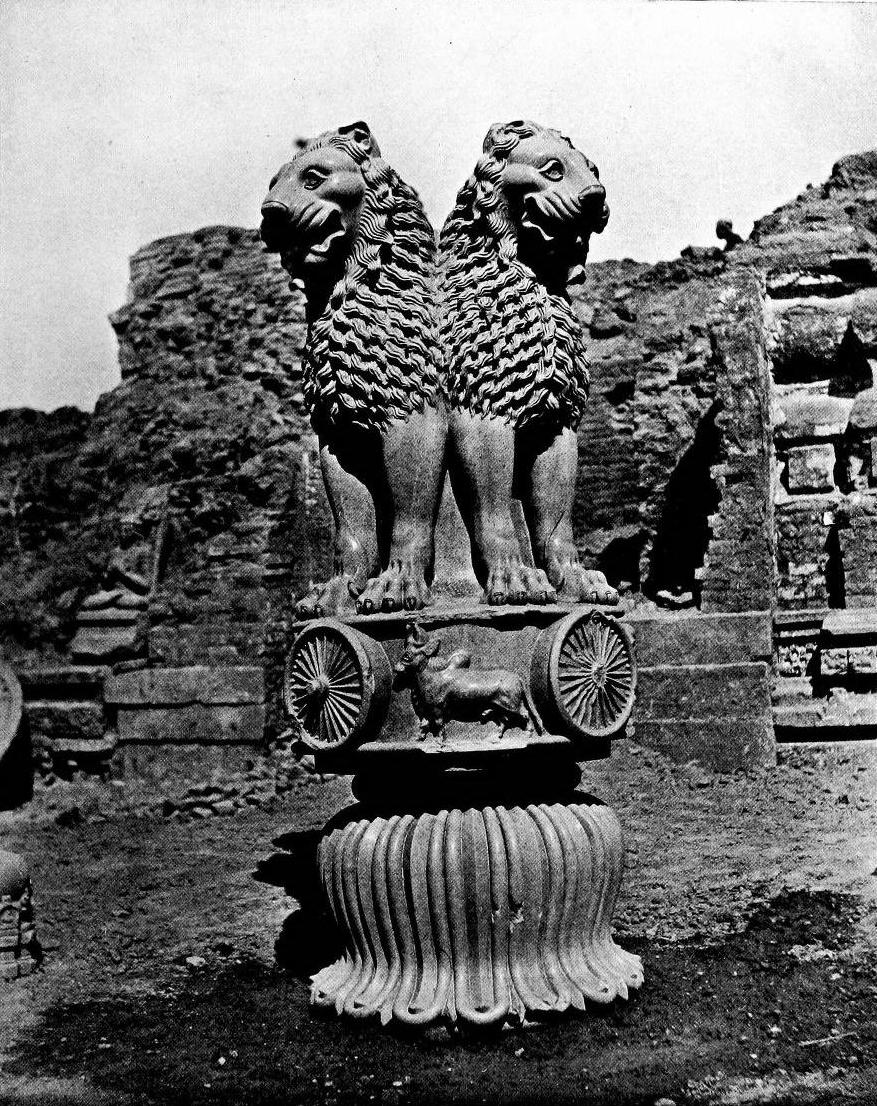
- (iv) Sarnath Pillar (Varanasi, Uttar Pradesh)- The crowing animal is four back-to-back lions.
- Sarnath Pillar highlights the importance of Buddha's first sermon, which is known as 'Dharmachakra Parivartan'.
- The upper part along with the abacus has been adopted as the national emblem of the government of India, along with a motto, Satyamev Jayate was taken from Mundaka Upanishad.
-
- Stupa (5:56 P.M.)
- Stupa is a Sanskrit word that means a heap of sand.
- Its origin can be traced to the Vedic age, where the divine Rishis of that time were cremated in stupa formations.
- Buddha also belonged to the same society, and when his death happened his followers also created a stupa on his cremated body.
- Later, Ashoka decided to create nine early stupas on the remains of Buddha at the following places:
- (a) Alakappa
- (b) Ramagrama
- (c) Vethadipa
- (d) Vaishali
- (e) Rajgir
- (f) Pippalvina
- (g) Pava
- (h) Kapilavastu
- (i) Kushinagar
- After the construction of early stupas, Ashoka initiated the 'Calm and Glad' policy.
- Under this, it was said that he constructed 84000 stupas.
- Through this policy, he wanted to make the hearts of the people calm and glad, by emulating the life of Buddha.
-

- Generally, stupas have an enclosure wall known as Vedika. Vedika is intervened by four gateways known as Toranas.
- These four Toranas depict four important life events of Buddha.
- The four gates of the stupas represent the following:
- (a) East Torana indicates his Birth at Lumbini.
- (b) South Torana indicates his enlightenment at Bodhgaya.
- (c) West Torana indicates Dharmachakra Parivartana at Sarnath.
- (d) North Torana indicates Mahaparinirvana (death) at Kushinagar.
- On the Toranas Jatak Kathas were also engraved.
- These are folk narratives about the previous lives of Buddha.
- Medhi is a closed structure which embodies the relics of Buddha.
- Devotees access the stupa from the Pradikshana Path, which is a circular pathway.
- Harmika is indicative of the most sacred space of the Stupa.
- Yashti represents the axis of the Earth, and three horizontally placed discs represent the three jewels (Triratnas) of Buddhism.
- Triratna of Buddhism
- (a) Buddha (Awakened One)
- (b) Dhamma (Doctrine of Buddhism)
- (c) Sangha (Monastic order of Buddhism)
- Stupa as Representation of Buddha (6:48 P.M.)
- Overall, Stupa is considered the microcosm of the universe, and the representation of Buddha himself.
- Medhi represents the meditating leg of Buddha.
- Anda represents the middle body of Buddha.
- Hermika, Yashti, and Chhatri represent the head of Buddha.
SCULPTURE OF MAURYAN AGE (7:10 P.M.)
- In the Mauryan age, the sculptures of Yaksha and Yakshini were created. They were folk god and goddesses.
- These figures were represented in the Buddhist stupas and were highly revered in Hinduism and Jainism.
- For example, Yaksha is mentioned in Mahabharata, as the demi-god associated with preservation of the order of nature.
- Yakshini is mentioned as a demi-goddess in Hinduism, associated with fertility and the acquisition of wealth.
- In Jainism, there existed the concept of 24 Yakshinis who were highly revered.
- In Buddhism, Yakshini figures are considered as highly auspicious.
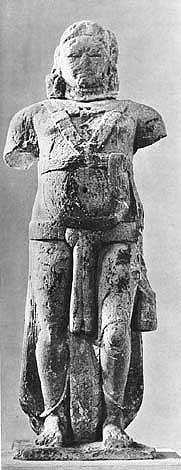
- Similarly, Yaksh is regarded as a deity of power and strength.
- For example,
- (a) Didarjanj Yakshini
-

- (b) Yaksha of Parkham
-
- (c) Salbhanjika Yakshini of Sanchi Stupa.
-

- In this image, Yakshini is depicted holding a branch of Sal tree.
MAURYAN POTTERY (7:24 P.M.)
- The characteristic pottery of the Mauryan age was Northern Black Polished Ware.
- It was the climax of Pottery making.
- Mauryan Pottery was highly polished and very even in nature.
- They used very fine particles of clay after removing the coarse grains.
- As a result, the smooth pottery was created and polished to a greater extent.
POST-MAURYA ART
- Cave Architecture
- Structure-wise Cave Architecture
- There were three types of structures of cave architecture created during this period.
- (a) Apsidal Vault Cave with Pillars
-

- For example, Ajanta Caves, Bhaja Caves, Karla Caves, Kanheri Caves, etc.
- (b) Apsidal Vault Cave without Pillars
-
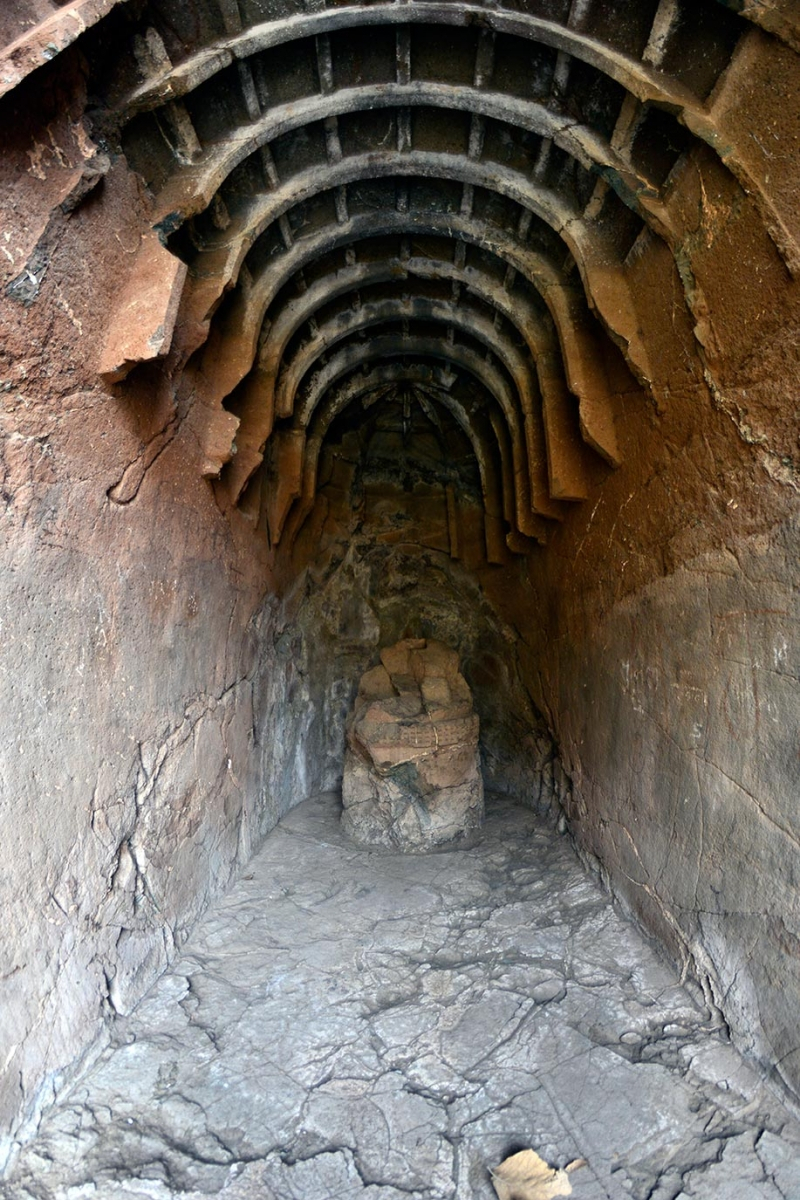
- For example, Thana Nandsur Cave and Pithal Khora Cave.
- (c) Quadrangural Hall Flat Roof Caves
-
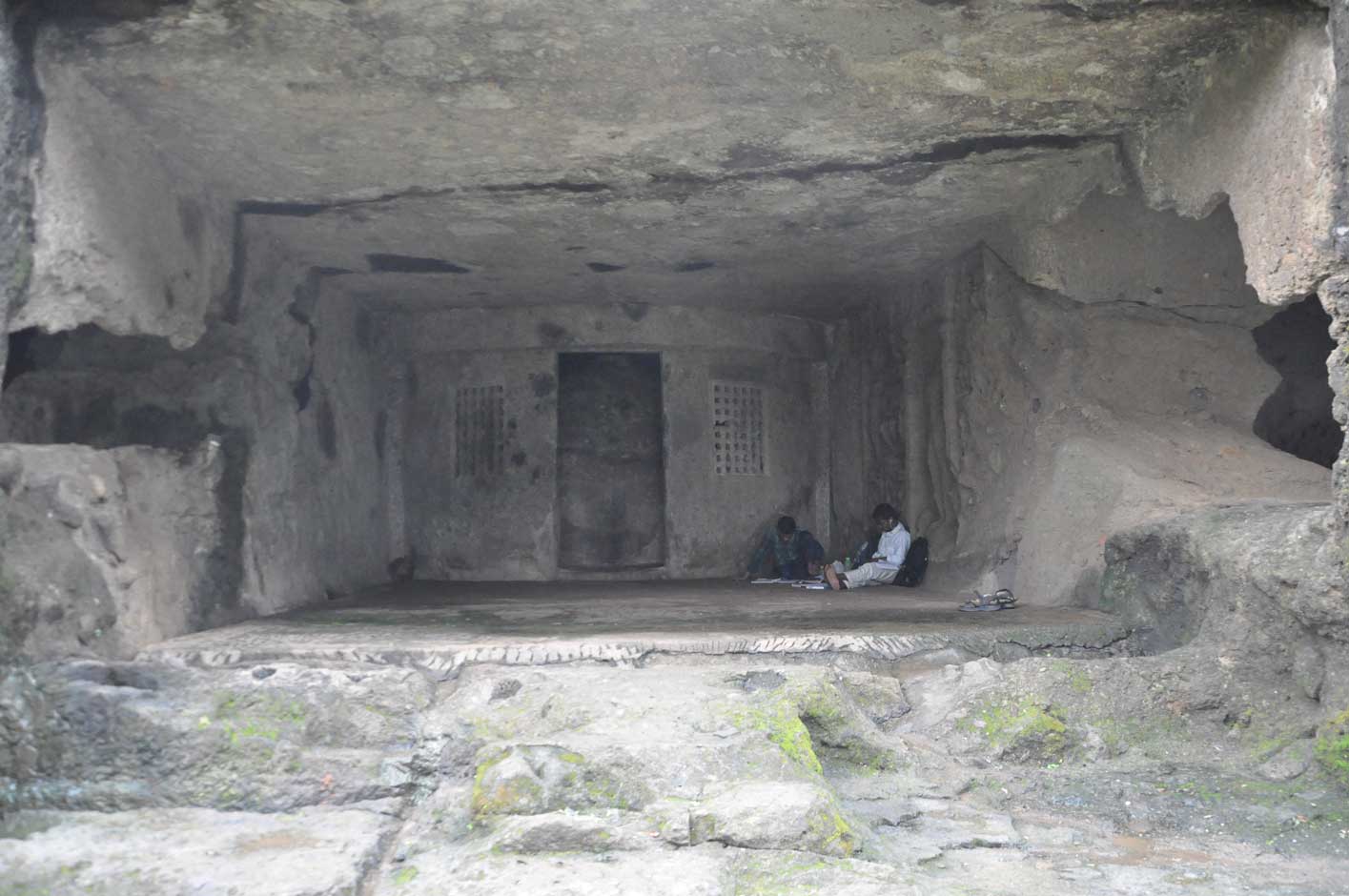
- For example, Kondivite Cave.
- Purpose-Wise Caves
- (a) Chaitya Caves
- These were prayer halls for the monks.
- These had pillars and votive stupas.
- (b) Vihara Caves
- These were the resting places for the monks, particularly in the monsoon season.
THE TOPIC FOR THE NEXT CLASS: POST-MAURYAN ART (CONTINUED)